Enthusiasts have known for a long time that speed and driving enjoyment are not the same thing. Now, apparently, science is catching up with us.
A recent study commissioned by Castrol attempted to measure what actually makes driving exciting. Researchers concluded that the strongest experiences came from a combination of physical stimulation, mental engagement and emotional excitement. Simply going faster didn't necessarily make the experience better. In fact, once excitement crossed over into fear, enjoyment began to diminish.
That conclusion immediately made sense to me. I've driven plenty of very fast cars, but some of the most enjoyable weren't particularly fast at all. Our NA Miata certainly isn't, and neither were the early Lotus Elises by today's standards. Yet both can make an ordinary road enormously entertaining.

The study got me thinking about what separates a car that is merely fast from one that is genuinely engaging. After more than forty years working around cars, building them, developing parts and driving them on the road and tracks, I've come up with my own interpretation.
I call them The 4Cs of Driver Engagement: Communication, Control, Challenge and Connection.
Communication
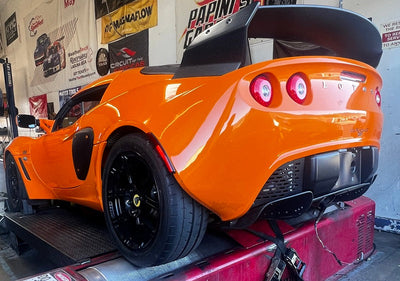
A great driver's car needs to talk to you, and few cars demonstrate this better than a Lotus Elise. The Elise's unassisted steering is the obvious example. Drive across a change in pavement and you feel it through the wheel. Load the outside front tire in a corner and you can sense what is happening at the contact patch. You also feel the chassis and suspension working through the seat, hear the engine changing character behind you and sense the car's movements as weight transfers under braking, cornering and acceleration.
Modern cars are remarkably good at isolating us from noise, vibration and harshness. That's desirable in a luxury sedan, but in a sports car there is a point where refinement begins removing useful information. The engineer's job isn't necessarily to eliminate everything the driver can feel. Sometimes it's deciding what the driver should feel, and Lotus has traditionally been very good at that distinction.

Control
Communication leads naturally to the second C: Control. When a car tells you clearly what it is doing, you become more confident using its capabilities.
Again, consider the Elise. Its modest size, low mass and relatively narrow tires mean you don't need absurd speeds to feel the chassis working. You can work the engine, gearbox and chassis without immediately arriving at speeds that could threaten your driver's license.
I've driven modern performance cars with staggering levels of capability that require speeds I simply don't want to explore on a public road. At some point, all that capability can distance the driver from the experience. Control isn't about having less performance. It's about having performance you can actually use.

Challenge
Challenge is where the driver's skill becomes part of the equation. A car doesn't need to be difficult or dangerous, but it should ask something of you and reward you when you get it right.
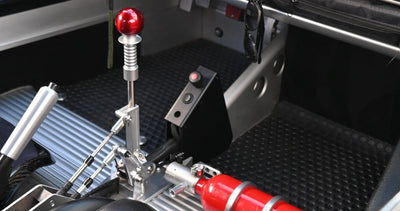
A manual transmission asks you to choose the correct gear. A naturally aspirated engine rewards keeping it in the useful part of the rev range, while a lightweight chassis rewards smooth braking, weight transfer and precise steering. Our Miata doesn't have enough horsepower to cover every mistake, so carrying momentum and getting the corner right becomes part of the fun.
But Challenge can advance with the driver's skill.
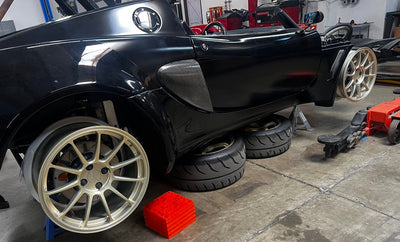
That's part of the thinking behind our Drakan Spyder. We wanted a car with some of the handling qualities we loved about the Elise, but with roughly three times the power and a much higher performance envelope. It demands considerably more from the driver.
A less experienced driver might have more fun exploring an Elise because its limits are accessible and forgiving. As skill develops, particularly on a racetrack, the equation changes. An advanced-level driver would likely choose the Drakan because its additional speed and capability provide another level of challenge.
More performance isn't automatically less engaging. Performance becomes engaging when the driver's ability is high enough to participate in it.

Connection
The first three Cs ultimately produce the fourth. When the car communicates clearly, you feel in control and it asks enough of you to remain mentally involved, you begin to form a connection with it.
Every enthusiast knows the feeling. You stop consciously thinking about steering angles, pedal pressure and gear selection. Your inputs become instinctive and the machine seems to shrink around you.
The Elise is exceptionally good at this because there isn't much separating the driver from the mechanical experience. You're sitting low and close to the road, the steering is immediate and the car reacts quickly enough that your inputs and its responses begin to feel like one continuous action.
It's why I've enjoyed cars as different as older Porsche 911s, Ariel Atoms, BAC Monos and our Drakan Spyder. Their engineering solutions differ, but the best versions accomplish the same thing: they make the driver feel like an essential component of the machine.

More Speed Isn't the Answer
Making cars faster has become almost absurdly easy. Electric motors deliver staggering acceleration, modern tires generate enormous grip, and computers can manage differentials, dampers, stability systems and torque distribution faster than any human could react. All of that technology can make a car objectively better, but it doesn't automatically make it more fun.
Perhaps the challenge for Lotus—and every company claiming to build cars for enthusiasts—isn't figuring out how to make the next generation faster. We already know how to do that. The harder job is preserving the things that make the driver matter.
The researchers describe driving enjoyment in terms of physical stimulation, mental engagement and emotional excitement. I'd describe the enthusiast version a little differently: Communication. Control. Challenge. Connection.
Speed is wonderful, and I'm certainly not arguing against it. But speed is only one ingredient. The 4Cs are what make us want to keep driving.